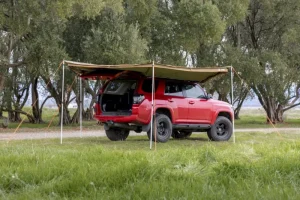
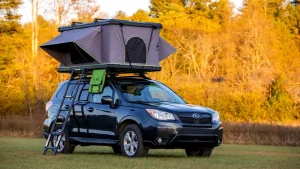
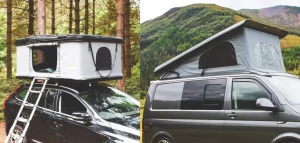
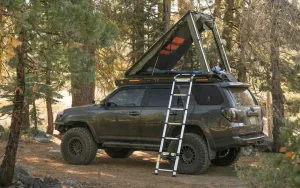
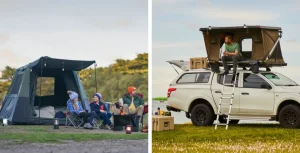
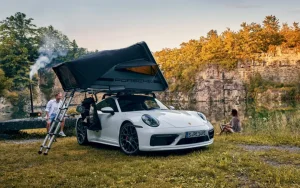
There are three main types of folding roof tents: soft-shell folding tents, hard-shell folding tents and hybrid pop-up tents. They each have their own advantages in terms of unfolding method, material, space utilization and price.
Soft-shell tents are suitable for entry-level users with limited budgets, hard-shell tents are more suitable for campers who are looking for efficiency and protection, and pop-up tents are suitable for traveling light and fast.
What is a folding roof tent?
Folding Rooftop Tent (RTT for short) is a kind of tent installed on the roof of the vehicle, designed to be folded and stored, to reduce wind resistance when driving, and quickly unfolded when camping. Compared with traditional ground tents, rooftop tents have higher safety, spatial independence and ease of construction, and have been widely loved by off-road players and self-driving camping families in recent years.
Classified by opening structure
1.Soft-shell Folding RTT
Structure: composed of waterproof canvas and aluminum alloy skeleton, usually unfolded by folding on one side.
Unfolding method: Folds to the side of the vehicle to create a larger resting space.
Advantages:
- Lower price, friendly to start;
- High space utilization, suitable for family or 2-3 persons;
- Can be used with side tent or canopy to expand more camping functions.
Cons:
- Folding and unfolding operations, need to be done manually;
- Folded state is not as compact as the hard shell type, wind resistance is slightly larger.
Suitable for: first time to buy a rooftop tent, multi-people traveling, limited budget.
2. Hard-shell Folding RTT
Structure: The top and bottom of the tent are wrapped with ABS or aluminum hard-shell, and the middle is canvas or Oxford cloth structure.
Unfolding method: It can be flipped forward, sideways or folded, which makes the structure more stable.
Advantages:
- Fast opening and closing, saving time and labor;
- Better wind and rain protection;
- More streamlined appearance, suitable for long time high speed driving.
Disadvantages:
- heavier than soft shells;
- more costly, need to have enough budget.
Suitable for: frequent camping, self-driving, those who value efficiency and durability.
3. Pop-up Hybrid RTT
Structure: Hard shell with folded soft-side canvas on top, which is popped upward by air or hydraulic poles.
Deployment: Vertical or diagonal pop-up, extremely easy to operate.
Advantages:
- Fastest unfolding speed, suitable for short stops;
- Small folding volume, does not take up much roof space;
- Minimalist design, stress-free city transportation.
Cons:
- Limited interior space, only suitable for single person or couple
- Functionality is weak, can not expand the vestibule or awning.
Who it’s for: camping around the city, short journeys, light traveling enthusiasts.
Breakdown by unfolding method
The unfolding method of a folding rooftop tent not only affects the ease of operation, but also directly determines the layout of the tent space and the number of people who can use the tent. Below are three common unfolding mechanisms, each with its own advantages and disadvantages.
1.Side-Opening
Structure: With one side of the roof as the hinge axis, the tent unfolds to one side like a book, and the bottom is usually supported by a foldable floor or platform.
Typical products: Commonly used in softshell tents, such as KingCamp, 171Outdoor and other entry or large space models.
Advantages:
- Large unfolding area, usually equipped with a width of 2.2 meters or more, can accommodate 2-4 people;
- Ladder and side tents can be attached to build a complete camping space;
- Suitable for a wide range of vehicles, including SUVs, MPVs, and pickup trucks.
Weaknesses:
- It takes more steps to unfold and unfold, especially in windy or rainy days;
- It is a bit too big to be stowed, which affects wind resistance to a certain extent.
- Recommended for: camping, small families, users who emphasize on space utilization.
2. Bi-fold / Clamshell
Structure: The tent is folded in the middle and unfolded, sometimes called “clamshell”. Commonly used in hard-shell tents, some soft-shell products also use this structure.
Representative brands: iKamper Skycamp, 171Glamping series.
Advantages:
- Compact and stable structure, not easy to shake when traveling;
- Smaller volume after storage, more smooth lines of the roof;
- Some products support built-in mattress, storage space and other functions.
Weaknesses:
- The interior space after unfolding is not as spacious as that of one-side folding;
- The durability of air pressure rods of some low-end models is limited.
Recommended for: users who pursue stability and fast construction, such as long-distance travelers and self-driving travelers.
3.Pop-up Hybrid
Structure: Supported by pneumatic rods or hydraulic brackets, the top cover pops upward, surrounded by folding canvas structures, similar to the roof design of RVs.
Typical examples: Thule Basin, Alu-Cab Gen3 Expedition.
Advantages:
- One-button setup experience in as little as 30 seconds;
- Extremely thin after folding, so it doesn’t interfere with daily commuting or garage access;
- Ideal for short-term camping trips or fast-paced travel.
Weaknesses:
- Relatively small interior space, most of them are only suitable for singles or couples;
- Poor expandability, can’t hang side tents or awnings externally.
Recommended for: urban camping enthusiasts, short weekend trips, lightweight equipment seekers.
Categorized by function and design differences
Different users have different functional needs for folding rooftop tents, and a variety of “value-added function” styles have been introduced in the market, and the following are the three more popular functional designs.
1.Sky Window
Core function: set up transparent or openable skylight on the top or both sides of the tent.
Common configuration: PVC transparent sheet + mesh fabric on the top for ventilation and stargazing.
Advantages:
- Night stargazing and moon viewing, enhancing the sense of outdoor immersion;
- Better ventilation, suitable for summer or tropical camping;
- Enhance the brightness of the tent, and more comfortable to use in the daytime.
Cautions:
- Proper sealing is needed to prevent water seepage in rainy days;
- PVC material is easy to aging, need to pay attention to maintenance
Suitable for: users who like night outdoor experience, summer campers.
2. Four-season Tent
Core Function: For cold or extreme weather, the tent is made of double-layer fabric or inner thermal insulation with anti-condensation design.
Main Configurations:
- Double-layer window structure (adjustable ventilation);
- Thickened fabrics such as 300D Oxford cloth + TPU coating;
- Windproof fasteners with fully enclosed zipper system.
Advantages:
- Available all year round, adaptable to low temperature, high altitude and other environments;
- Good heat preservation in winter, not easy to condensation;
- Excellent windproof performance, suitable for strong wind areas.
Price range:
Compared with the ordinary model, it is about 30%-60% higher, but the stability and comfort are significantly improved.
Suitable for people: plateau traversers, four-season camping players, extreme environment enthusiasts.
3. Awning + Annex Room
Core Function: The tent is equipped with a side tent or awning that can be added to create a larger and more flexible space for outdoor activities.
Typical forms:
- A single side tent (Annex) can be used to form a changing room, storage area;
- can be extended to form a kitchen area or shower room;
- The awning supports accessories such as hanging lights and netting.
Advantages:
- Create a semi-enclosed “outdoor living room” to enhance the family experience;
- Can cope with different weather changes, such as rain or sun protection;
- More privacy and practicality for multi-people camping.
Note:
- Installation and dismantling time is longer;
- Some models need to add additional brackets
Suitable for: family users who stay in the campsite for a long time, multi-functional space needs.
How to buy the right folding roof tent?
Choosing a folding roof tent is not an easy decision, it is not only about the comfort and convenience of the camping experience, but also directly affects traveling safety and budget arrangement. In order to choose a product that really suits you, it is recommended to start from the following five core dimensions and make a comprehensive evaluation.
First of all, you need to confirm whether the size and carrying capacity of the vehicle meet the installation requirements. Almost all rooftop tents require the installation of roof racks, so you must ensure that your car has the appropriate structure. At the same time, be sure to check the vehicle’s manual to confirm that its “dynamic load” limit can withstand the weight of the tent itself (usually between 45kg-75kg), otherwise there may be a hidden danger in high-speed driving.
Secondly, it is more practical to choose the type of tent according to your usage scenario. If you are keen on long-distance traversing and frequent camping, prioritize the hard-shell folding tent with high erection efficiency and solid structure. For family users who have limited budget or only travel short distances on weekends, soft-shell tents have more space and are more affordable, making them a more cost-effective option. For light camping around the city and for a quick opening and closing and portable experience, a pull-up pop-up tent is definitely the most suitable.
The space configuration of the tent also needs to be considered in advance, especially in terms of the number of people it can accommodate. For a one-person or couple’s trip, most tents will fit the bill, while for a family of three or more, it’s recommended to prioritize a soft-shell folding tent with a dual-side unfolding structure, which offers more sleeping space and internal activity areas.
If you plan to use the tent throughout the year in all seasons, especially in high altitude, cold or rainy or snowy climates, it is important to pay attention to the tent’s ability to insulate, protect against wind and condensation. A four-season tent is recommended for this type of situation, usually with a double-layer construction with reinforced materials. In contrast, softshell tents are more comfortable in summer or in milder climates, thanks to their better ventilation.
Finally, price and after-sales service are also factors that should not be ignored. Most of the soft-shell roof tents available in the market today are priced between $1,000-$1,800, while high-quality hard-shell tents are usually priced between $2,000-$3,500. It is recommended to choose a brand that has a good reputation and offers warranty and parts support, as this will protect the tent from minor problems such as damaged zippers and deformed brackets, which may render it unusable.
In summary, to buy a suitable folding roof tent, the model match, the use of demand, budget level, climate adaptability and after-sales protection should be unified into the scope of consideration. Only by making trade-offs according to your own actual situation can you truly enjoy the sense of outdoor freedom brought by convenience, safety and comfort in every camping journey in the future.
Conclusion
Folding Roof Tent is a piece of equipment that greatly enhances the camping experience, and different types correspond to different usage needs and budgets. Before purchasing, it is recommended to clarify your travel mode, travel frequency and vehicle conditions, so as to select the most suitable type of tent. If you are a first-time camper, you can also start with a softshell starter model and optimize the equipment configuration in practice.
If you need to recommend a specific product or vehicle fit chart, please feel free to leave a comment or private message for customized suggestions.