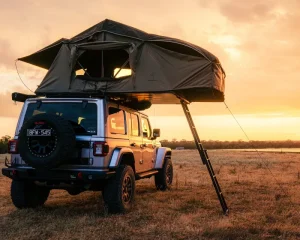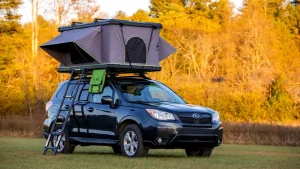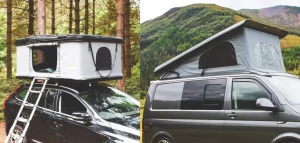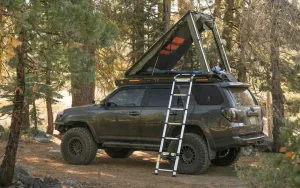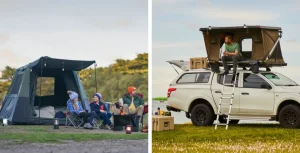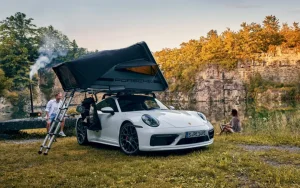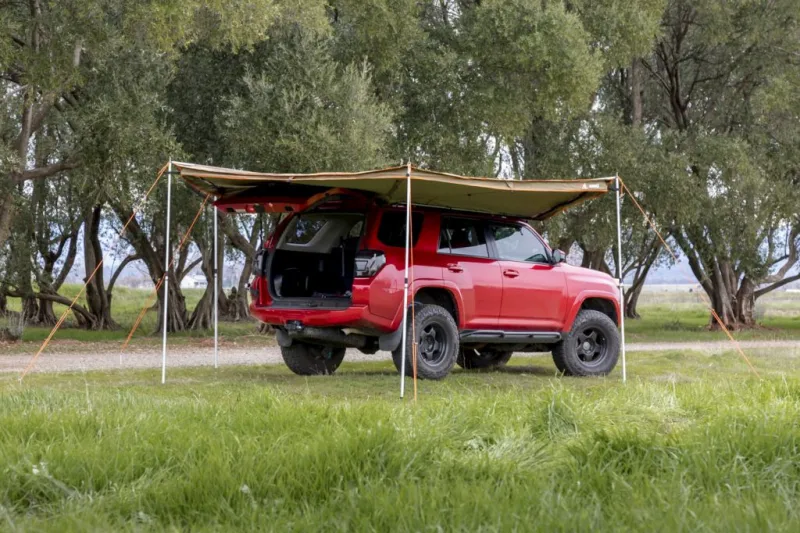
The main difference between 270-degree vehicle side canopy and straight side canopy lies in the unfolding angle, coverage area and ease of use.
270-degree awnning canopy extends to the left and right with the rear of the vehicle as the center to form an L-shape or even U-shape sunshade range, which is suitable for long-time stationing and encircling shelter needs; while the straight side canopy unfolds along the side of the vehicle only, with a simple structure and easy installation, which is better suited for short breaks and the use of small vehicles.
There are also significant differences between the two in terms of price, structure, suitable models and applicable scenarios.
Structural Differences: Expansion Angle and Coverage
In terms of structural design, 270 awning canopies and straight-sided canopies show obvious differences. 270-degree canopies are usually equipped with three to four rotatable movable arms, which are deployed from the side of the vehicle close to the rear, forming an encircling L-shape or close to U-shape sunshade area.
This design not only covers the side of the vehicle, but also extends to the tailgate area for a total shade area of 11 to 13 square meters, providing campers with more complete shade. Some of the higher-end models even have a “self-supporting” feature that allows them to be set up quickly without additional support poles in less windy conditions, which greatly improves their efficiency.
In contrast, the straight-sided canopy is much simpler. It usually unfolds in a zigzag pattern, relying only on two supporting legs and a horizontal telescopic pole to hold it in place, covering an area of roughly 5 to 6 square meters, and limited to one side of the vehicle. Due to its simple structure and light weight, a straight-sided canopy is easier for a single person to install and store independently, making it especially suitable for short trips or temporary parking.
Overall, the 270 awning canopy has a significant advantage in terms of coverage and functionality expansion, and is suitable for camping scenarios with long time stationing or multi-point activities; while the straight side canopy emphasizes more on portability and flexibility of operation, and is ideal for light travel or easy use in single person journeys. There is a sharp contrast between the two in terms of functionality and convenience.
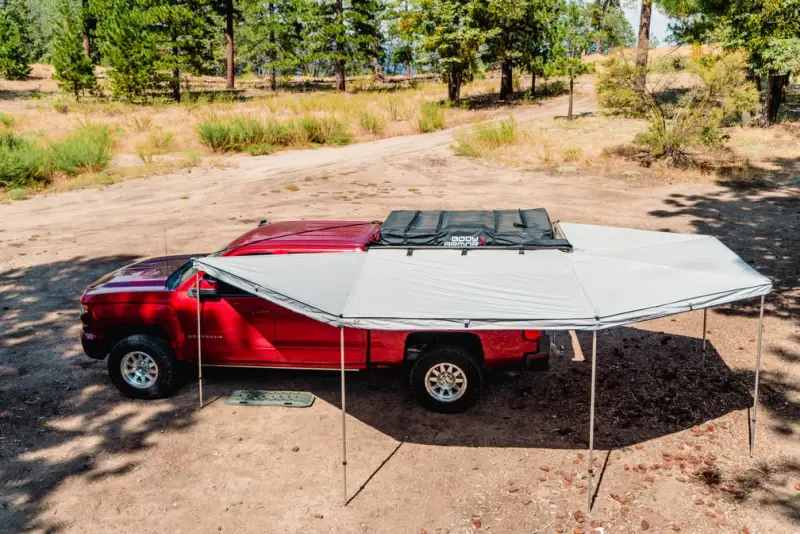
Differences in Use: Applicable Scenarios and Camping Methods
In terms of actual use scenarios, the 270 awning canopy and the straight-edge canopy show their own unique advantages and adaptability.
The 270-degree canopy is particularly suitable for multi-day camping, cross-country traversing and other long-stay outdoor activities due to its larger unfolding angle and shading range. It not only provides full shade for the side and rear of the vehicle, but also naturally extends multi-functional spaces such as “outdoor kitchen”, “changing room” or “storage area” to meet diversified camping needs.
In addition, the 270 awning canopy usually has good compatibility for expansion, and it can be used to hang side, mosquito or rear tents to further enhance the privacy and comfort of the space. This type of configuration is especially suitable for campers or families who need to stay in the campsite for a long period of time with a lot of gear.
In contrast, the straight-sided canopy is more suitable for short-distance lightweight camping. For light-duty scenarios such as one-day driving trips, fishing at the beach, picnics on the beach or lunch breaks in the woods, the straight-sided canopy can be quickly deployed with its simple structure and light weight, providing users with an instant solution for sun and rain protection.
For those who don’t need the space to cover the rear of their vehicle, and who emphasize convenience over extended functionality, the Straight Edge Canopy is a cost-effective and practical option. Particularly suitable for solo travelers or small vehicles, it is very user-friendly to install and operate.
To summarize, the 270-degree canopy is more oriented towards a multifunctional, long-stay camping experience, while the straight-sided canopy is suitable for short stays and daily portable use. Users should make a reasonable judgment when choosing based on their travel mode, activity days and space requirements.
Comparison of Applicable Models
In terms of applicable models, 270 awning canopy and straight side canopy also have their own installation characteristics and vehicle matching requirements.
Due to its more complex structure and wider coverage, the 270 awning canopy is usually suitable for medium and large SUVs, pickup trucks, crossover vehicles or RVs with strong load-carrying capacity. Most of these canopies are mounted on the side of the roof and extend to the rear of the vehicle, so they need to be coupled with reinforced aluminum rails or additional wind braces to ensure good stability when deployed. Especially in windy or long-time stationing scenarios, the 270-degree canopy requires high requirements for roof strength, crossbar rigidity and installation techniques.
In contrast, the straight-sided canopy has a relatively simple structure and is less demanding on the vehicle. It is more suitable for mounting on the roof side of an average SUV, station wagon or small pickup truck, and can be installed with universal brackets for flexible mounting positions without covering the rear area of the vehicle. Most straight-sided canopies support direct mounting on roof racks or roof decks, which is more adaptable and especially suitable for city cars or light off-road vehicles.
It should be noted that the weight of a 270 awning canopy usually ranges from 25 to 35 kilograms, which not only requires roof loading, but also affects wind resistance and fuel consumption at high speeds. Straight-sided canopies, on the other hand, are lighter, mostly under 15 kilograms, and are suitable for a wider range of car models and driving habits.
Therefore, the choice of which type of canopy, not only to consider the use of scenarios and functions, but also need to be combined with their own vehicle’s structural load-bearing capacity and modification of space to make a comprehensive judgment.
Price Comparison: Budget Considerations
In terms of price, 270 awning canopies and straight-sided canopies also show significant differences. 270-degree canopies typically have a higher price range, typically ranging from $600 to $1,200 or more, with prices fluctuating depending on brand, material, and additional features. Because 270-degree canopies often support external side tents, these accessories are often sold as options and cost between $100 and $400. At the same time, the overall weight of a 270-degree canopy is heavier, usually between 25 and 35 kilograms, reflecting its complex construction and higher manufacturing costs.
In contrast, straight-sided canopies are generally more affordable, with average prices typically ranging from $150 to $400. Some models come with side tents or shade accessories, but most require additional purchase. In terms of weight, straight-sided canopies are generally lighter, usually in the 8- to 15-kilogram range, making them easier to carry and quicker to install.
Overall, the 270 awning canopy, with its wider coverage area and versatile design, is on the higher end of the cost and price spectrum, making it suitable for users with specialized camping needs or frequent off-roading. The straight-sided canopy, on the other hand, has the advantage of a lower price and lighter weight, making it a cost-effective choice for novice or occasional travelers. Users with limited budgets and uncomplicated needs prefer straight-sided canopies to meet basic sun and rain protection needs.
Difficulty of Storage and Setup
In terms of storage and setup, there is also a significant difference between the performance of the 270-degree canopy and the straight-edge canopy. 270 awning canopy has a more complex structure, so the process of unfolding and retracting is relatively time-consuming, and it usually takes 3 to 5 minutes to unfold it completely even for a skilled user. In addition, it takes up more roof space due to its larger stowage volume, which has an impact on the load of the roof rack and the vehicle’s appearance. For first-time users, the installation and stowage of the 270-degree canopy may take some practice and experience to complete successfully.
In contrast, straight-sided canopies are much easier and quicker to erect. Most straight-sided canopies can be unfolded in 1 to 2 minutes and folded relatively easily for one-person operation and rapid deployment. Its compact size is not only easy to carry, but also ideal for low-body or compact vehicles, minimizing the impact on the overall height and space of the vehicle.
Therefore, if you pursue a quick and convenient use experience, the straight-sided canopy is undoubtedly a more suitable choice; while if you have a greater need for space and are willing to spend time mastering the building skills, the 270-degree canopy can bring a wider sheltered space and a richer range of use functions.
270 awning and a straight awning How to choose?
If you often go on long-distance camping trips or cross-country traverses, need to cover the side + rear areas of your vehicle, or plan to build a more complex campground layout, a 270-degree canopy will greatly enhance the comfort and functionality;
If you are only going on occasional weekend trips, picnics, or short stops, don’t want to add too much burden on the roof of your vehicle, and have a limited budget, a straight-side canopy will be a much lighter and cost-effective choice.
Conclusion
Overall, 270 awning canopy and straight-sided canopy have their own advantages, and choosing the right type of canopy should be considered in the context of your own camping needs, vehicle conditions and budget.
Whether you are looking for a large space and multi-functional professional camping, or prefer a lightweight and fast short trip, 171Outdoor provides a wide range of high-quality canopy products to meet the diversified needs of different users.
If you are looking for the best side canopy for your car and camping style, please feel free to contact us for customized product recommendations and detailed quotes to make your outdoor life easier and more enjoyable.