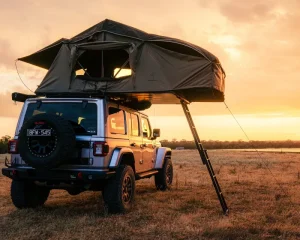
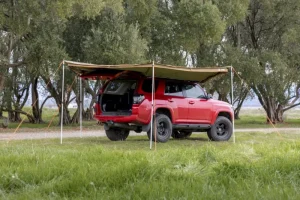
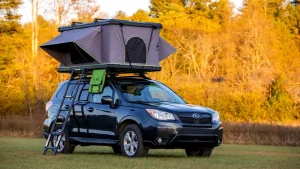
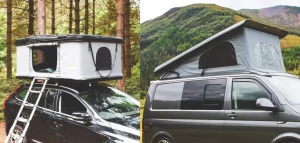
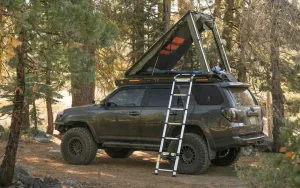
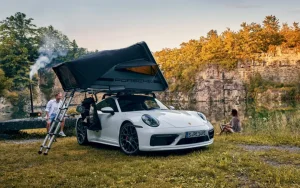
In the world of backcountry camping, a tent is more than just temporary shelter; it’s an important barrier between you and nature. Rooftop Tents and Ground Tents are two common choices, each with its own advantages and disadvantages. But as the outdoor lifestyle evolves, more and more backcountry enthusiasts are turning to a more efficient, safe, and comfortable solution – the roof tent.
In this article, we will compare these two types of tents from multiple dimensions to help you find the best off-road camping partner for you.
Safety: roof tents are better
Safety always comes first when camping in the wild. Although the ground tent has a high degree of freedom, it is also easy to encounter insects, snakes, or small beasts “night visit”. If you are camping in the rainy season or wetland areas, water accumulation at the bottom of the tent and ground seepage are also common troubles.
The roof tent is set up on top of the car, naturally elevated, and can effectively avoid ground moisture and small animal interference. Night rest is more at ease, especially suitable for forests, grasslands, and other complex terrain, truly “high above the cold, winning in peace of mind”.
Efficiency and Convenience
As many off-road veterans know, the time and complexity of setting up a tent directly affects the camping experience.
- It usually takes 10-30 minutes to set up a ground tent, especially when the wind is strong or the ground is uneven, which is time-consuming and laborious.
- Roof tents are mostly folding or quick-open designs, such as the hard-shell one-piece tent, which can be set up in as fast as 30 seconds by unlocking, unfolding, and fixing the tent, which greatly saves time.
For car owners who frequently change campsites and love to travel light, the convenience of roof tents is a “revolutionary” improvement.
Comfort and space: each has its own advantages, but roof tents are neater
In terms of space, high-end ground tents can usually accommodate more people and are also suitable for multi-person camping and use with living room tents. But this often means more volume and complex transportation and setup.
Although roof tents have limited space, usually accommodating 2-3 people, the integrated design of the sleeping pads and the leveling of the ground make for a better sleeping experience, so you don’t have to worry about stones, grass roots, or bumps in the ground affecting your sleeping experience.
In addition, the roof tent is not easy to accumulate dust and water, and the interior is more tidy, so you do not need to clean the ground or dry the bottom of the tent every day.
Adaptability to off-road environment
In real off-road scenarios, you may face the following challenges:
- Insufficient floor space or uneven ground.
- Frequent rainfall and dew.
- Windy nighttime makes the tent unstable.
At this point, the advantages of a roof tent are immediately apparent – as long as the car can be parked, you can sleep. No need to examine the terrain, no fear of mud and slippery, so that camping is more free.
Price and Budget Considerations
When it comes to price, ground tents have a significant initial cost advantage. Basic models usually cost only $50-$150 and are suitable for novice or occasional campers. High-quality roof tents typically cost between $800-$3000, depending on brand, material, and features.
But in terms of durability and long-term cost, roof tents are more cost-effective:
- One-piece construction for better water, wind, and sun protection.
- High-grade fabrics and brackets for a longer lifespan of 5-10 years or more.
- For frequent campers or long-distance travelers, the average cost per trip is lower, and there are fewer breakdowns and no need to replace them more often.
In short:
- If you only camp occasionally on weekends and have a limited budget, a ground tent may be able to meet your basic needs.
- But if you drive all year round, love off-roading, and are looking for experience and efficiency, then investing in a high-performance roof top tent would be a smarter choice.
Rooftop Tent vs. Ground Tent Comparison Table
Comparison Dimensions | Ground Tent | Roof Tent |
Safety | Easily affected by ground animals and moisture | Off-ground design, better protection |
Building efficiency | Time-consuming to build, depending on the terrain | Rapid unfolding, easy to operate |
Comfort | Large space, varying comfort | Sleeping mat integrated, neat and smooth |
Terrain adaptability | Need to choose flat ground to set up | Parking, adaptable |
Cost | Cost Low, suitable for beginners | Higher cost, but more cost-effective in the long run |
Conclusion
There is no absolute good or bad in the comparison between roof tents and ground tents, the key lies in your frequency of use, budget, and the need for comfort and convenience. If you desire to be ready to go, quick to set up, and comfortable in a variety of wilderness environments, then a roof top tent is undoubtedly a worthwhile investment in camping gear.
Among many brands, 171Outdoor, with its rich design experience and strict manufacturing standards, offers a wide range of practical and cost-effective roof top tent solutions, covering hard shell, soft shell, quick-open and other types, which are popular among off-road players and outdoor enthusiasts.
Upgrade your camping style now, starting with choosing a roof tent that really suits you.