Introduction
With the growing popularity of outdoor activities, the functionality and design of awnings, as an important part of the outdoor space, has become an important consideration for consumers when making their choices. Among the many types of awnings, 270 and 180 awnings have attracted attention for their unique angular coverage. These two types of awnings are not only different in appearance but also show their own characteristics in terms of usage scenarios, functionality, and installation requirements.
In this article, we will discuss the differences between 270° and 180° awnings from multiple dimensions and analyze them in detail with the actual situation and usage scenarios, so as to help you make a wise choice according to your own needs.
Definition and Basic Structure
1. What is a 270 Awning?
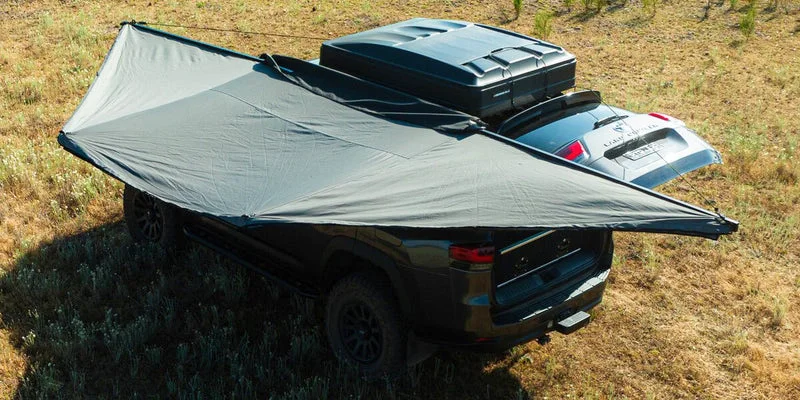
A 270° awning is an outdoor shading product that can provide a three-side wrap-around shading effect. It provides users with greater shade coverage and better privacy protection by spreading the shade fabric or material around the bracket to create a coverage area close to three-quarters of the circumference.
- Coverage Angle:270° awnings provide a wider range of shade for scenes that require multi-directional shading.
- Structural Features:Usually supported by a center column with an adjustable tension cable system to ensure that the awning can remain stable under different wind conditions.
2. What is a 180 Awning?
A 180 awning, on the other hand, is a shade product with a semi-circular cover design. It is limited to a shade angle of 180° and is designed to provide shade in a single direction. This design makes the 180° awning lighter and easier to install.
- Coverage Angle:180° awnings are suitable for small outdoor spaces where only one-way shade is required.
- Structural Features:Generally adopts a simple frame structure, quick installation, and easy to carry.
Function and Performance Comparison
1. Shading Range
270° Awning:
- Provides a wider range of shading for scenarios that require all-around shade, such as patio corners, deck edges, and more.
- Can effectively block direct sunlight from multiple directions and reduce heat buildup.
180 Awnings:
- Primarily aimed at blocking sunlight in a single direction, suitable for small gardens, balconies, or outdoor dining areas.
- Provide adequate shade in a limited space but are less capable of shading in other directions.
2. Stability
270° Awnings:
- Typically require stronger frames and more wind-resistant designs due to the larger area covered.
- Equipped with wind cords and ground spikes, they are able to resist strong winds to a certain extent.
180° Awnings:
- Relatively less wind resistant due to smaller coverage area and overall lighter weight.
- More suitable for use in low wind speed environments or indoor space extensions.
3. Sun Protection and Thermal Insulation
270° Awnings:
- Use high-density sun protection material that effectively reduces UV radiation while minimizing heat ingress.
- More suitable for long hours of outdoor activities or hotter spaces. Can be used in a variety of outdoor environments.
180° Awnings:
- Also offer good sun protection but may be slightly less effective at insulating due to the smaller coverage area.
- More suitable for short outdoor activities or use in cooler climates.
Usage Scenarios and Applicable People
1. Scenarios for 270° Awnings
- Family Courtyard:Provides a spacious recreational area for family members, suitable for barbecue parties or children’s activities.
- Commercial Venues:Outdoor seating areas in restaurants, cafes, or retail stores, providing a comfortable dining environment.
- Large Events:Music festivals, exhibitions, or wedding venues, providing multi-faceted shade for participants.
2. Scenarios for 180° Awnings
- Private Balconies:To provide shade for the balcony of a small house or apartment, suitable for daily rest or reading.
- Picnics and Camping:The lightweight and easy-to-carry design makes it ideal for outdoor trips.
- Small Gatherings:Simple get-togethers between friends or family members that don’t require too much shade coverage.
Installation and Maintenance
1. Installation Difficulty
270° Awnings:
- Due to the complexity of the structure and the large area covered, the installation process may require the collaboration of several people.
- It is recommended to choose a flat ground and reserve enough space for easy operation.
180° Awnings:
- Simple structure and relatively easy installation process, suitable for individuals to complete independently.
- The position and angle can be quickly adjusted according to actual needs.
2. Maintenance Requirements
270° Awnings:
- The frame and connecting parts need to be checked regularly to see if they are secure, to ensure safety in long-term use.
- Mild detergent is recommended for cleaning to avoid damaging the shade fabric.
180° Awnings:
- Maintenance is relatively simple and only requires regular wiping of surface dust.
- If the shade fabric is found to be torn, it can be replaced in time to prolong its service life.
Price and Value for Money of 270 and 180 Awning
1. Price Differences
270° Awnings:
- Prices are usually higher than those of 180° awnings because of the larger coverage area and more complex structure.
- Depending on the brand and material, awnings can be more expensive than those of 180° awnings. The market price can be around $200-$500 or more.
180° Awnings:
- Simple in design and lower in cost for those on a budget.
- The price range for a regular model is roughly $50-$150.
2. Price/Performance Analysis
270° Awnings:
- If you need a versatile and durable shade solution, a 270° awning is certainly a worthwhile investment.
- Particularly suited to scenarios where large events are frequently held or where long-term use is required.
180° Awnings:
- For occasional use or when only a small area of shade is required, the 180 awning is more cost-effective.
- Their lightness and affordability make them ideal for short-term outdoor events.
Frequently Asked Questions about 270 and 180 Awning
Q1: How to choose the right awning for me?
Choose the right angle of coverage according to the actual use demand. If you need all-round coverage, give priority to 270° awnings; if only one-way coverage, 180 awnings are more suitable.
Q2: Can awnings withstand bad weather?
Most high-quality awnings are specially treated to provide some water, wind, and sun protection. However, in extreme weather conditions, it is recommended that the awning be retracted to prevent damage.
Q3: Do awnings need to be professionally installed?
Depends on the specific model. 270° awnings usually require more than one person to collaborate to complete the installation, while 180 awnings are more suitable for individuals to operate independently.
Conclusion
270 and 180 awnings have their own merits, and the choice should be considered in the context of your needs and budget. If you’re looking for greater coverage and stability, a 270° awning is ideal, while if you’re more interested in portability and affordability, a 180 awning can also meet your daily needs.