How to choose 180-degree vs 270-degree awnings?When it comes to outdoor camping, overlanding, and other outdoor activities, awnings are essential gear. Whether it’s for providing shade or protecting against harsh weather conditions, choosing the right awning is crucial. Two common types are 180-degree awnings and 270-degree awnings. So, how do you choose the right one for your needs? This article will delve into a detailed comparison of the 180-degree vs 270-degree awnings, considering factors such as application scenarios, advantages and disadvantages, costs, and more, helping you make an informed decision.
Why Choose an Awning? Needs Analysis
The primary function of an awning in outdoor activities is to provide shade, protect against rain, increase space, and safeguard equipment. With the increasing popularity of outdoor camping and overlanding, choosing the right awning has become essential for every outdoor enthusiast. The choice between 180-degree awnings and 270-degree awnings depends on your specific needs.
Shade Protection Needs: If you often spend long hours outdoors, an awning will provide comprehensive shade, preventing sun exposure. The choice between a 180-degree or 270-degree awning largely depends on your environment, the duration of your activities, and the required shade coverage.
- Recommended for 180-Degree Awnings: If you are going for short-term camping or outdoor activities and only need shade on one side, a 180-degree awning is sufficient. It’s ideal for providing shade on one side of your vehicle or tent, especially in milder climates or when the sun is not very intense.
- Recommended for 270-Degree Awnings: If you plan on longer camping trips or activities that require more extensive shade protection, a 270-degree awning is the better choice. It offers comprehensive shade, making it ideal for extended outdoor camping or group activities, especially in summer or high-temperature areas.
Space Expansion Needs: Awnings not only provide shade but also expand your usable space, especially in multi-person camping or when additional storage space is needed.
- Recommended for 180-Degree Awnings: If your activities are smaller in scale, such as solo or two-person camping, and you don’t need much additional space, a 180-degree awning provides adequate space. This type of awning takes up less room and is perfect for tighter camping spots.
- Recommended for 270-Degree Awnings: For larger camping setups or group activities that need more space, a 270-degree awning is more suitable. It offers a larger covered area, providing enough space for rest areas, dining, and equipment storage.
Weather Protection Needs: In harsh weather conditions, the wind and rain protection provided by an awning becomes essential. When choosing an awning, consider the climate and environment where you’ll be camping.
- Recommended for 180-Degree Awnings: If your camping location has stable weather with minimal wind and you’re only staying for a short time, a 180-degree awning will provide adequate protection. It’s especially suitable for mild weather conditions, effectively blocking the sun and ensuring comfort.
- Recommended for 270-Degree Awnings: If you are camping in areas with frequent strong winds or sudden rainstorms, a 270-degree awning provides additional protection. Its larger coverage area can better mitigate the impact of rain and wind, ensuring that you remain comfortable and safe in more extreme weather conditions.
Application Scenarios of 180-Degree vs 270-Degree Awnings
In everyday use, 180-degree and 270-degree awnings each have their advantages, depending on the needs and environment.

Application Scenarios for 180-Degree Awnings
A 180-degree awning is typically a single-sided shelter, ideal for users who don’t require extensive shade coverage, have a limited budget, or have limited space. Its strength lies in its portability and ease of setup, making it ideal for solo or small family use.
- Ideal for Solo or Small Family Camping: A 180-degree awning covers one side of a vehicle, making it perfect for short camping trips or recreational activities with two or three people.
- Space-Saving: Since it only provides shade on one side, it occupies less space compared to a 270-degree awning, making it ideal for smaller camping sites or when a more compact setup is needed.
- Lower Cost: For outdoor enthusiasts on a budget, 180-degree awnings are more affordable, meeting basic shade requirements.
Application Scenarios for 270-Degree Awnings
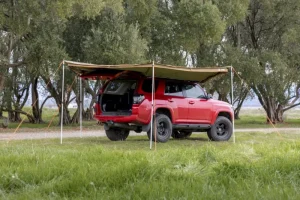
A 270-degree awning provides more comprehensive shade protection and is ideal for larger camping setups or group outdoor activities. It typically covers both sides and the rear of a vehicle, creating a more spacious camping area.
- Ideal for Group Camping and Extended Stays: A 270-degree awning provides broader coverage, making it perfect for family or group camping trips, or overlanding adventures.
- Adapts to Complex Outdoor Environments: Whether you’re in the desert, mountains, or forest, the 270-degree awning can provide ample shade and protection for your camping area.
- More Space Expansion: Besides providing shade, the 270-degree design usually expands the outdoor living space, which can be used as a resting area, dining area, or storage space, suitable for those who need more space and convenience.
Comparison of Advantages and Disadvantages
Advantages and Disadvantages of 180-Degree Awnings
Advantages:
- Portable and Easy to Carry: The simple design and lightweight structure of the 180-degree awning make it easy to transport and set up, ideal for solo campers or quick setups.
- Easy Setup: Typically, it requires minimal tools and installation time, perfect for short trips and temporary use.
- Lower Cost: Generally more affordable compared to 270-degree awnings, making it suitable for those with limited budgets.
Disadvantages:
- Limited Shade Coverage: With only one side covered, it cannot provide comprehensive protection for larger areas, making it ideal for smaller camping or outdoor activities.
- Limited Space: The smaller coverage area may not be sufficient for larger groups or big events.
- Limited Applicability: In extreme weather conditions, such as strong winds or heavy rain, a 180-degree awning may not provide adequate protection, especially in harsher camping environments.
Advantages and Disadvantages of 270-Degree Awnings
Advantages:
- Comprehensive Shade Coverage: The 270-degree design covers three sides, offering larger coverage for a variety of environments and conditions.
- Flexible Space: It provides more space around your vehicle or camping area, effectively expanding your living area.
- Strong Weather Protection: In harsher weather conditions, the 270-degree awning offers better protection against wind and rain.
Disadvantages:
- Heavier: Due to its larger coverage, the 270-degree awning is typically heavier and not as suitable for frequent disassembly or carrying.
- More Time for Setup: The installation of a 270-degree awning is more complex than that of a 180-degree one, making it more suitable for users with some camping experience.
- Higher Cost: Due to the complex design and larger coverage, 270-degree awnings are generally more expensive, which may not be ideal for those with a tighter budget.
180-Degree vs 270-Degree Awnings Cost Comparison
When choosing an awning, cost is an important factor. The price difference between 180-degree and 270-degree awnings mainly depends on materials, size, features, and the brand.
Model | Price Range | Suitable Scenarios | Advantages | Disadvantages |
180-Degree Awning | $200-$500 | Small Family Camping, Short-term Activities | Lightweight, Affordable, Easy Setup | Limited Shade Coverage, Small Application |
270-Degree Awning | $500-$1000+ | Group Camping, Extended Stays | Comprehensive Shade, Larger Space, Weather Protection | Heavier, Expensive, Complex Setup |
How to Choose the Right Awning for Your Needs
When selecting between a 180-degree and 270-degree awning, consider the following key factors:
- Frequency of Use: If you’re an occasional camper for short trips, a 180-degree awning might be more suitable. For frequent overland trips or multi-person camping, a 270-degree awning offers more shade and space.
- Activity Scale: For smaller activities or short-term camping, a 180-degree awning will meet your needs. For family camping or larger group activities, a 270-degree awning provides more comfort and larger coverage.
- Budget: If your budget is limited, a 180-degree awning might be a more economical choice, but if you have a larger budget and are seeking higher comfort and functionality, a 270-degree awning will be a better investment.
Recommended: 171 Outdoor – A Leading Manufacturer of Awnings
If you’re looking for high-quality awnings, consider 171 Outdoor, a company specializing in the production and customization of outdoor awnings. 171 Outdoor offers a variety of 180-degree and 270-degree awning options designed to provide enhanced protection and comfort for outdoor enthusiasts.
Why Choose 171 Outdoor?
- Quality Assurance: 171 Outdoor’s awnings are made with high-quality materials and undergo rigorous quality control to ensure durability and long-lasting performance.
- Customizable Options: 171 Outdoor offers custom sizes and features to suit different camping needs.
- Expert Design: With years of design experience, 171 Outdoor’s awnings are both functional and stylish, seamlessly fitting into your camping style.
Interested in learning more? Contact us today to get professional advice and find the perfect awning for your outdoor adventures.
Conclusion
In conclusion, whether to choose a 180-Degree vs 270-Degree Awnings entirely depends on your individual needs, the scale of your activities, your budget, and how often you plan to use the awning. For simple, short-term camping, a 180-degree awning is sufficient, and it’s more affordable. For larger-scale activities, group camping, or more extreme weather conditions, a 270-degree awning offers better protection and more space.
After reading this detailed comparison, we hope you now have a clearer understanding of the differences between the two and can make an informed decision based on your specific needs. Regardless of which awning you choose, it will bring more comfort and convenience to your outdoor activities.